

Rising Together: How Collaboration Can Shape a Staircase
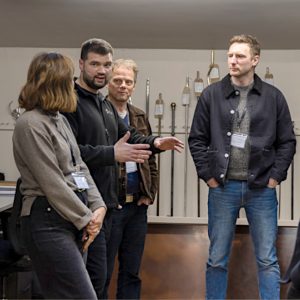
At Bisca HQ, our January Staircase Discovery Day was never intended as a showcase – it was designed to initiate debate and share knowledge in both directions.
Yes, we benefit from three decades of expertise in bespoke staircase collaborations. But equally important, our guests, many sought after architects and interior designers, shared how staircase decisions shape their projects structurally, spatially, and creatively. The day highlighted one enduring truth…
A staircase is rarely simply a means of connecting levels. It is a junction where architecture, engineering, material choices, and spatial experience converge. When a staircase is integrated early, design freedom flourishes.
Two-way dialogue is at the heart of every successful project – as staircase specialists it is Bisca’s role to help professionals unlock the full potential of a staircase, while aligning ambition with reality. It is worth noting too, that timing is a factor that can greatly affect, or even limit a staircase’s impact on the wider project.
Where Design Freedom Begins
Timing really does seem to define success. Initiating a bespoke staircase specialist at concept stage of a building or interior design project transforms the staircase from a reactive element, into a design driver. Structural strategy evolves with ambition; circulation and sight-lines are refined; while rise, going, and head height become design tools rather than merely compliance checks.
At Bisca’s Staircase Discovery Day, we distilled our 6-step staircase planning process into a practical framework which can be applied to an architect or interior design project:
1. Vision – Understand how the staircase should feel, not just function.
2. Concept Design – Explore form, flow, and layout in the context of the building.
3. Engineering Integration – Resolve structure early to avoid later compromise.
4. Material & Detailing – Consider staircase balustrade, handrail, lighting, and finishes as a unified system.
5. Precision Manufacture – Translate drawings into engineered reality.
6. Installation & Completion – Deliver seamlessly, protecting design integrity.
Early bespoke staircase collaboration ensures these aspirations are supported, not constrained.
Guest Architect, James Maclean of Maclean Architecture reflects.
There is great freedom of design at Bisca, but this is backed up with a very professional set-up that would give any designer or client confidence that the product will be delivered to specification.
Beyond the Drawings… Creativity Meets Craftmanship
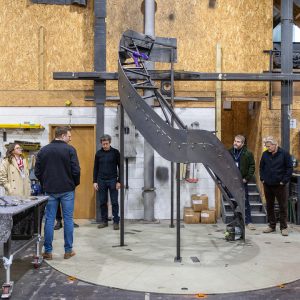
Perhaps the most energising moments came not from theory, but from practice. Standing beside staircases mid-production – from sculptural helical structures to minimal glass balustrades – the conversation shifted from aesthetics to application. Several architects commented that seeing this process clarified how to better coordinate clients and consultants to maximise outcomes.
As one reflected, “seeing first-hand how a bespoke staircase is engineered gave him confidence to push design boundaries, understanding that through collaboration, solutions could be realised rather than compromised.”
Stephen Clark of Johnson Clark Building Surveys and Architecture observed:
“You comfortably took me from a perception that your staircases were expensive – to not knowing how you could charge any less. There is one thing for sure, at Bisca it is clearly not about the money; the focus is entirely on the level of service, design and craftmanship that is offered.“
Three practical principles for industry professionals if considering a bespoke staircase design:
Design the staircase as a system – that is to say balustrade, treads, handrail, lighting, and structure must all work together.
Protect sight-lines early – especially important for glass staircases, where flow and transparency define space.
Respect the geometry – helical and curved staircases demand rhythm, proportion, and precision; consider both function as well as aesthetic.
In the world of staircases – the real meaning of bespoke brings together integrity, confidence, and design that transcends the ordinary.
Seeing Is Believing…
“For me, there is simply nothing that can replace standing beside a bespoke staircase mid-production – or witnessing the care invested in every detailed aspect of a balustrade. Watching the drawings come to life is by far the most rewarding stage of what we do,” explains Richard McLane, Founder and Design Director at Bisca.
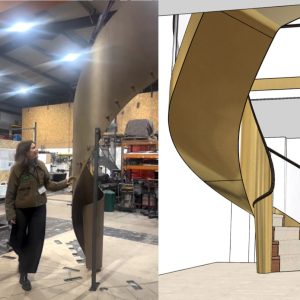
It was plain to see that nothing really demonstrates the impact of a bespoke staircase collaboration, like experiencing it. Sarah Whatmore of Webster Interiors joined our Discovery Day, with a bronze feature staircase in the process of manufacture – a sweeping helical structure with a liquid metal wall and stitched leather handrail. Her client’s vision translating in to reality, before her eyes. Stephen Clark reflected:
“Behind the glossy photos, people might assume elements are sourced. From my visit it was clear the foundations of what Bisca does, and the excitement present – comes from the workshop and how every element is crafted in-house.”
Across the room, architects acknowledged a subtle but powerful truth: when staircase planning is integrated early – paired with an expert design and crafting process such as that which Bisca offers – both control, confidence, and creativity are tangibly apparent. If you have a bespoke interior or architectural design project coming up and would like to book a design consultation, or to visit Bisca’s premises yourself – please contact our friendly team on the details below: